
Current Affairs
White House Defends Taxpayer-Funded Political Advertisements; Experts Question Legality
The Trump administration is defending taxpayer funded political ads totaling $1.5 million, but legal experts and lawmakers question whether federal funds can lawfully sup

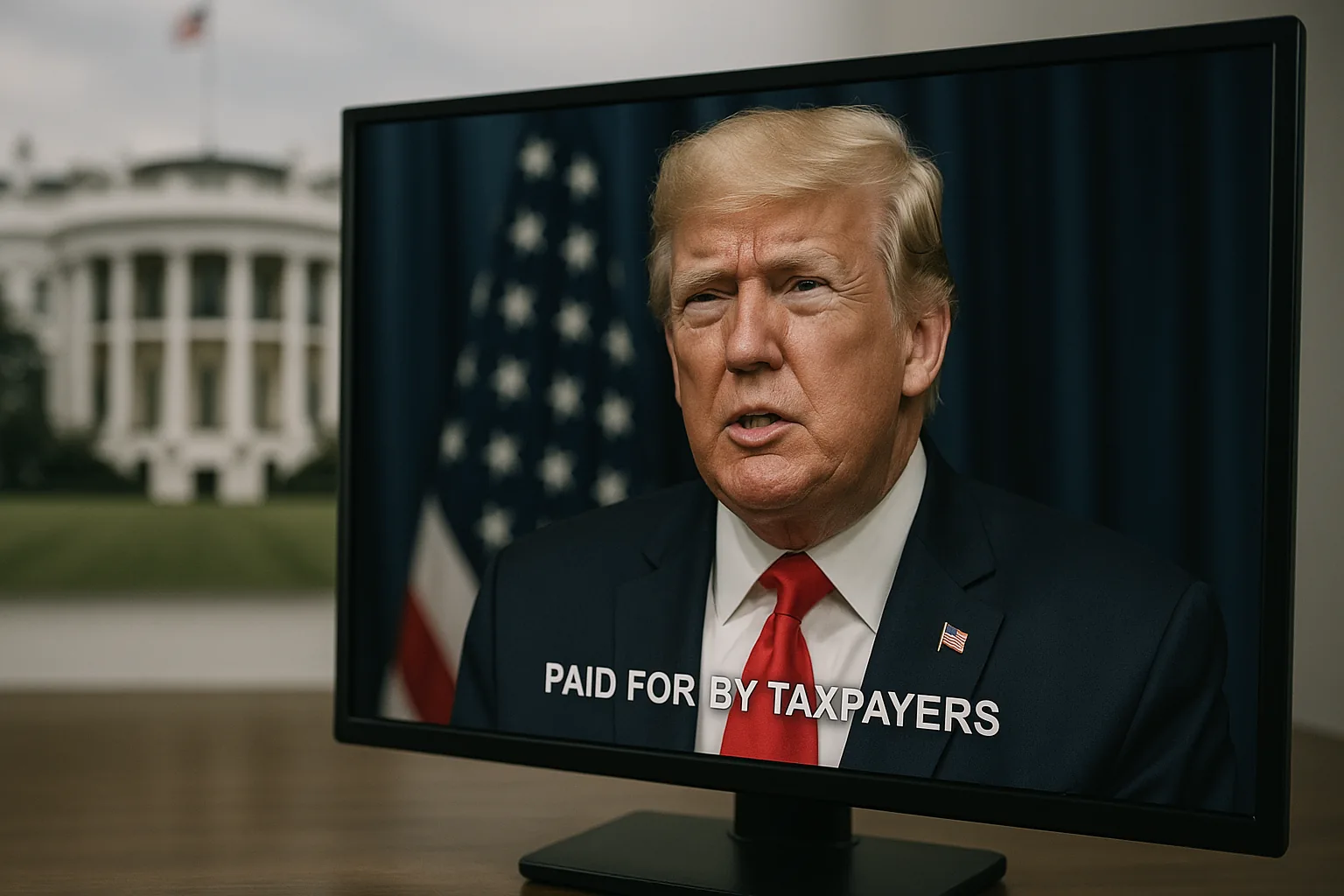
A series of taxpayer funded political ads released by the Trump administration in late September 2026 — just weeks before the midterm elections — has ignited a sharp legal and political debate that now spans party lines, congressional chambers, and federal courtrooms. The White House has characterized the spots as routine public outreach, but legal experts, Democratic lawmakers, at least two senior Republican senators, and the Democratic National Committee have all raised serious questions about whether federal funds can lawfully be used to broadcast what critics describe as partisan political messaging. The controversy touches on foundational questions about the appropriate use of public money, the boundaries of executive authority, and the integrity of government communications in a charged electoral environment.
What the Ads Actually Contain
The advertisements at the center of the controversy feature President Donald Trump prominently, alongside depictions of the U.S. military. One ad includes a voiceover from Dana White, president of the UFC, praising the president. The content goes beyond imagery: at least one ad contains the voiceover, “Together we will defeat communism, socialism and Marxism in America.” That phrase — a direct ideological declaration — is precisely what has drawn the most sustained legal scrutiny, because it tracks closely with partisan campaign rhetoric rather than the kind of neutral, informational messaging typically associated with government public service announcements.
Perhaps the most striking detail is structural rather than rhetorical. One of the ads is described as almost an exact copy of an advertisement that was aired by the Trump-Vance campaign leading up to the 2024 election. If accurate, that parallel raises an immediate question: if the content was previously used as campaign material, on what legal or ethical basis can it now be repackaged and broadcast using federal appropriations? That question has not been answered to the satisfaction of legal experts who have reviewed the spots.
The ads have been running on Fox News and Newsmax, cable outlets with large conservative audiences. Their placement on those specific channels, rather than on broader broadcast networks, has added to the perception among critics that the campaign is targeted at a partisan viewership rather than the general American public.
The Scale of Taxpayer Funded Political Ads
The financial dimension of the controversy is substantial. According to reporting cited by Poynter, more than $1 million has likely been spent airing the ads. A separate figure, referenced in additional reporting, puts the total closer to nearly $1.5 million in taxpayer-funded advertising expenditure. The discrepancy between those two figures reflects the difficulty of tracking federal media buys in real time, but both numbers confirm that this is not a minor or incidental expenditure — it is a significant and deliberate allocation of public funds toward a specific communications campaign.
To put that figure in context: $1.5 million in federal advertising spending, directed at specific cable news audiences in the weeks immediately preceding a midterm election, is the kind of outlay that would, in any other context, be described as a political advertising campaign. The timing — weeks before the midterm elections — has been noted by multiple observers as a factor that compounds the legal and ethical concerns, since the proximity to an election makes it harder to argue that the ads serve a purely governmental informational purpose.
The White House Defense
The administration has not been silent. White House communications director Steven Cheung took to X to push back against media coverage of the controversy, posting: “Don’t let the Fake News get away with their lies about our epic Public Service Announcements that have been running on tv.” That framing — public service announcements — is the core of the White House’s defense. The administration has characterized the ads as being meant to remind “Americans to love their country,” positioning them as patriotic outreach rather than political advertising.
→ Read also: Trump Administration Claims on Medicaid Drug Savings and Taxpayer-Funded Ads Lack Substantiation
The distinction between a public service announcement and a political advertisement is not merely semantic — it carries legal weight. Genuine public service announcements typically convey factual, non-partisan information: how to apply for federal benefits, how to prepare for a natural disaster, or how to access government services. An ad featuring a sitting president, a celebrity surrogate, military imagery, and a pledge to defeat specific political ideologies does not fit neatly into that category, at least not by the standards that legal experts and government accountability organizations typically apply.
The White House’s characterization has not persuaded even some members of the president’s own party, a fact that underscores the breadth of the concern the ads have generated.
Republican Voices Join the Criticism
The political significance of the backlash is heightened by the fact that it is not confined to the Democratic opposition. Senate Majority Leader John Thune of South Dakota told reporters directly that the ads “shouldn’t be paid for with taxpayer dollars.” That statement from the chamber’s top Republican is notable: Thune is not a reflexive critic of the administration, and his willingness to break publicly with the White House on this issue signals that the discomfort within the Republican caucus is genuine.
Sen. Mike Rounds, also of South Dakota, offered a similarly measured but clear rebuke. Rounds said: “It would not have been something that I would have done. And I know that the White House is not covered by the same guidance that we are, but it’s not something that I would have done.” Rounds’s acknowledgment that the White House operates under different guidance than members of Congress is an important nuance — it reflects the real complexity of the legal landscape — but his personal distancing from the practice is unmistakable.
The fact that two Republican senators from the same state, including the majority leader, have both publicly questioned the use of taxpayer funds for these ads suggests that the controversy has genuine cross-partisan traction. It is not simply a Democratic talking point.
Democratic Lawmakers Push Back Through Official Channels
On the Democratic side, the response has been more aggressive and more formal. Sen. Maggie Hassan sent a letter to the White House asking for detailed information about the funding source of a 30-second commercial that has been in rotation on Fox News and Newsmax. Hassan’s request for transparency reflects a broader pattern of Democratic scrutiny: if the administration is spending federal funds on these ads, lawmakers have a legitimate oversight interest in understanding exactly which appropriations are being used and under what legal authority.
Beyond Hassan’s individual inquiry, Democratic appropriators in both the House and Senate sent a joint letter to the White House calling for the first ad to be pulled from the air. That collective action by members of the appropriations committees — the lawmakers most directly responsible for overseeing how federal funds are spent — is a significant escalation. Appropriators have both the institutional standing and the political motivation to press this issue, and their involvement suggests the controversy is unlikely to fade quickly.
The Democratic response has operated on two tracks simultaneously: formal congressional oversight, through letters and inquiries, and legal action through the courts.
→ Read also: Political Ads Misrepresent Candidates' Tax and Social Security Positions
The DNC Lawsuit and What It Alleges
The most consequential development in the controversy to date is the lawsuit filed by the Democratic National Committee, which alleges that the taxpayer funded political ads constitute illegal propaganda. The DNC’s legal action, reported by PBS NewsHour, frames the ads not merely as a political misstep but as a violation of federal law. The lawsuit represents a formal attempt to have a court determine whether the administration’s use of federal funds for this kind of advertising crosses a legal line.
Legal experts consulted by The Associated Press have said that the ads appear to raise legal questions, and that the Trump White House commercials may violate laws including a prohibition against using federal funds for political purposes. It is important to be precise here: the experts have identified the ads as raising legal questions and as potentially violating federal prohibitions — they have not, at least in the sources available, rendered a definitive verdict. The legal proceedings initiated by the DNC may ultimately produce that determination.
What is clear from the verified record is that the concern about legality is not confined to partisan critics. Multiple independent legal experts, consulted by a wire service with no institutional stake in the outcome, have flagged the same issues. That convergence of expert opinion lends weight to the conclusion that the legal questions here are substantive, not merely rhetorical.
Why the Timing Matters
The release of the ads in late September 2026, weeks before the midterm elections, is not incidental context — it is central to the legal and ethical analysis. Federal law places particular constraints on the use of government resources in proximity to elections precisely because the potential for abuse is highest at those moments. When a sitting president’s image, paired with ideologically charged language and a celebrity endorsement, is broadcast on partisan cable channels using public funds shortly before voters go to the polls, the argument that the content serves a purely governmental informational purpose becomes considerably harder to sustain.
The parallel between one of the current ads and a 2024 Trump-Vance campaign advertisement is particularly difficult to explain away in that context. Campaign ads are, by definition, political. If the content of a campaign ad and the content of a purported public service announcement are nearly identical, the distinction between the two becomes a matter of funding source and legal label rather than actual substance — and it is precisely that distinction that the courts and Congress are now being asked to examine.
What Remains Unresolved
Several important questions remain open. The specific legal statutes or constitutional provisions that the ads may violate have not been definitively established in the public record — legal experts have pointed to a prohibition on using federal funds for political purposes, but the precise statutory framework is a matter for litigation and legal analysis rather than settled fact. It is also not established whether the White House has formally asserted that the ads comply with all applicable federal regulations.
What is established is the basic factual record: the ads exist, they cost between $1 million and $1.5 million in public funds, they contain explicitly ideological content, they closely resemble prior campaign material, they were released weeks before a midterm election, and they have drawn criticism from legal experts, Democratic lawmakers, Republican senators including the Senate majority leader, and the DNC through formal litigation. The White House’s characterization of the spots as public service announcements has not resolved those concerns — it has, if anything, sharpened them by drawing attention to the gap between that label and the ads’ actual content.
As the DNC lawsuit moves forward and congressional oversight inquiries continue, the controversy over taxpayer funded political ads is likely to remain a live issue through and beyond the midterm elections. The outcome of the legal proceedings will have implications not only for this administration but for the norms governing how future administrations may use federal communications resources in politically sensitive periods.
This article was produced with AI assistance and reviewed editorially.

Political Ads in 2026 Midterms Contain False or Misleading Claims About Opponents

Trump Administration ‘Super Intelligence’ Accord Misspells ‘United States’ as ‘Unites States’

Trump Administration ‘Super Intelligence’ Accord Misspells ‘United States’ as ‘Unites States’

No Going Back PAC Ad Makes Misleading Claim About Roy Cooper and Rape Kits
